
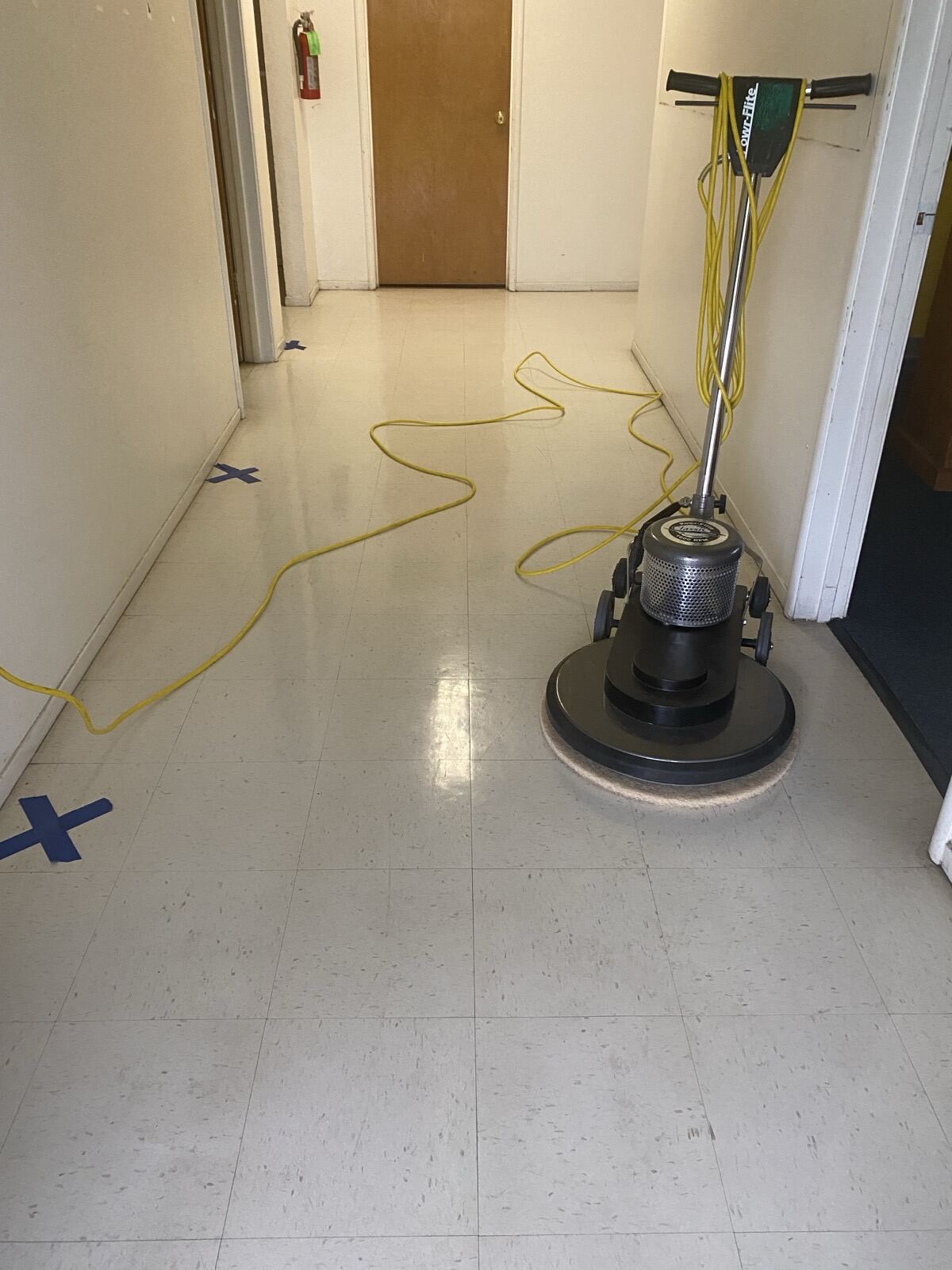
Most cleaning crews burnish over tired finish. That keeps a floor looking busy — it does not fix yellowed, built-up, or worn-through wax. On VCT and resilient hard floors, the real choice is usually strip & wax or scrub & recoat (interim).
Timla Floor Restoration scopes both across the Highway 50 & I-80 corridor. Guessing wrong either wastes money on a full strip or leaves a floor that still looks tired after a recoat.
Side-by-side
| Strip & wax | Scrub & recoat | |
|---|---|---|
| What it does | Removes all old finish down to the floor, then rebuilds coats | Removes the top worn layer and adds 1–2 fresh coats |
| Best when | Finish is yellowed, built up, deeply scratched, or patchy | Base finish is still sound but gloss is gone |
| Disruption | Longer overnight / weekend job | Faster maintenance cycle |
| Cost | Higher per visit | Lower between full strips |
| Typical cycle | Annual to 18 months in heavy traffic (varies) | Months between strips, as traffic demands |
Burnishing alone will not fix a failed film. Scrub-and-recoat will not fix a floor that needs a strip.
When strip & wax is the right call
Choose a full strip & wax when:
- Finish is yellowed or cloudy even after cleaning
- Coats are thick and built up at edges and under furniture lines
- Traffic lanes are worn through to the tile
- Prior coats are peeling, powdering, or patchy
After the strip, we rebuild commercial finish in thin coats with dry time between coats — then you get a floor that can take a real maintenance program.
When scrub & recoat is enough
Choose scrub & recoat / interim when:
- The floor still has a healthy base film
- Gloss is gone in lanes but the finish is not yellowed through
- You want shine without paying for a full strip every cycle
- You are between planned strip windows (schools, retail, offices)
Interim work is how facilities stretch the life of a strip job — not a substitute for one when the film has already failed.
How Timla decides on site
- Survey — surface type (VCT, vinyl, linoleum, etc.), condition, square footage, edges, access
- Specify — strip vs scrub-and-recoat, coat count, overnight or weekend window
- Protect — baseboards and adjacent areas so the rest of the facility stays usable
- Restore — strip or scrub, neutralize, recoat, optional burnish
- Maintain — notes for the next recoat so the next strip is planned, not an emergency
Published starting floors are on the pricing guide — strip & wax from $0.55 / sq ft, scrub & recoat from $0.30 / sq ft. The assessment locks the number for your floor. For a deeper cost breakdown, read how much strip & wax costs.
What to tell us for a fast scope
Facility type, floor material, approximate square footage, and when traffic can leave the floor (nights/weekends). Photos of traffic lanes and edges help. Most deep jobs run overnight or weekends so cure time clears before open.
Next step: Request a floor assessment · Call 916-868-4634 · Or browse strip & wax and scrub & recoat.