
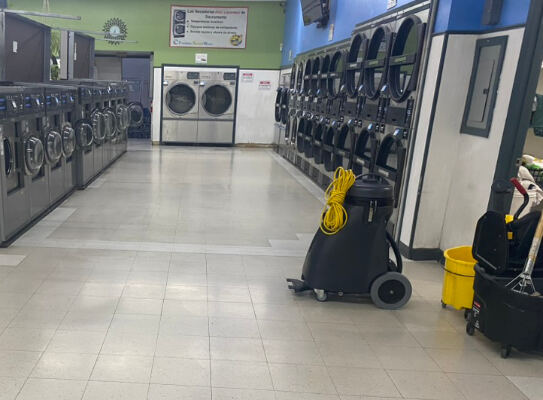
Most cleaning crews burnish over tired finish. When the wax is yellowed, thick, or scarred through to the tile, the floor needs a full strip and recoat — not another top coat.
Timla Floor Restoration strips commercial and residential hard floors across the Highway 50 & I-80 corridor, then rebuilds finish in controlled coats so the result lasts under real traffic. Published starting floor: from $0.55 / sq ft — locked after assessment.
Strip & wax vs scrub & recoat
| Strip & wax | Scrub & recoat | |
|---|---|---|
| What it does | Removes all old finish down to the floor, then applies fresh coats | Removes the top worn layer and adds 1–2 new coats |
| Best when | Finish is yellowed, built up, deeply scratched, or patchy | Floor still has sound finish but has lost gloss |
| Disruption | Longer overnight / weekend job | Faster maintenance cycle |
| Cost | Higher per visit | Lower between full strips |
If you are not sure which you need, read strip & wax vs scrub & recoat or request a floor assessment. Guessing wrong either wastes money on a full strip or leaves a floor that still looks tired after a recoat.
When a full strip is the right call
A full strip is usually the right path when you see one or more of these:
- Yellow or amber film that burnishing cannot clear — old finish has oxidized or built up in layers
- Traffic lanes worn to the tile while edges still look thick and cloudy
- Deep scratches, black marks, or patch repairs that sit in the finish, not just on the surface
- Peeling, powdering, or soft film after years of mopping and burnishing over failed coats
- A “dull after every buff” cycle — the base film is gone; gloss will not hold
Scrub & recoat (interim maintenance) still has a place between full strips when the base coats are sound. Burnishing alone will not fix a failed film.
Floors we strip and refinish
- VCT — the classic strip-and-wax floor in schools, retail, offices, and clinics
- Vinyl / linoleum — only with chemistry matched to the material (aggressive VCT strippers can damage linoleum)
- Other resilient hard floors — scoped on site when the finish system allows stripping
We do not treat every surface the same. Hardwood, natural stone, and many LVT products need different processes — we will say so up front rather than force a strip cycle that ruins the floor. For wood care paths, see hardwood; for tile that needs grout restoration rather than wax film, see tile & grout.
VCT vs vinyl notes (why chemistry matters)
VCT is designed for repeated strip-and-finish cycles with commercial strippers and finish systems. Sheet vinyl and linoleum often need milder chemistry and tighter dwell control — the wrong stripper can haze, soften, or permanently dull the wear layer. LVT and many “no-wax” products are not strip-and-wax floors at all.
That is why Timla scopes material first, then process. Photos of the floor and a close-up of an edge or damaged tile usually tell us enough to recommend strip vs scrub vs a different service before we roll a truck.
How a Timla strip job runs
- Survey — surface type, condition, square footage, edges, access, and curing time before foot traffic returns
- Specify — confirm strip vs scrub-and-recoat; coat count; overnight or weekend window
- Protect — edges, baseboards, and adjacent areas so the rest of the facility stays usable
- Strip — remove old finish, agitate soil and buildup, recover slurry, rinse
- Neutralize & dry — balance the floor so new finish bonds cleanly
- Recoat — apply commercial finish in thin, even coats with dry time between coats
- Document — photo set and maintenance notes so you know what was done and when to recoat next
Overnight and weekend windows
Most commercial strip jobs run overnight or on a weekend so staff and customers return to dry floors. Coat count and cure time drive the outage — expect several hours between coats and often 4–8+ hours after the last coat before normal foot traffic (longer before rolling loads). Commercial overnight work is priced at 1.5× the scoped job; details live in the pricing guide and overnight cleaning pages.
Ideal for
- Schools and universities with worn hallway VCT
- Retail and offices where first impressions matter
- Medical and clinic floors that need a clean, durable reset
- Property managers scheduling after-hours work so daytime traffic is not interrupted
- Multi-tenant corridors where one failed wing makes the whole floor look neglected
What drives the price
Published floor for strip & wax is from $0.55 / sq ft. The locked number moves with:
- Condition — built-up or worn-through finish takes longer than a light reset
- Square footage and layout — edges, fixtures, and cut-up rooms add machine and hand time
- Access — elevators, security, and occupied buildings add logistics
- Coat count and cure window — more coats mean more on-site hours
- Prep — furniture moving and excessive soil removal are scoped separately when needed
Small jobs still meet the $150 job minimum (before trip / after-hours fees). Corridor drive time is built into published floors for listed service locations; out-of-area travel is $1.50 / mile round trip. Full fee table: pricing guide. Cost context: how much does strip & wax cost?.
What you get from the assessment
Before we quote a locked number, we need facility type, floor material, approximate square footage, and access (nights/weekends). Photo/video assessment is free. On-site walks are not free (Rancho Cordova from $10; other ZIPs by location from our Gold River warehouse).
You get a written scope: strip vs recoat, expected window, coat expectations, and what happens after the last coat before the floor can take traffic again. No surprise add-ons after that assessment.
Request a floor assessment · Call 916-868-4634
Frequently asked questions
When do I need a full strip & wax instead of scrub & recoat?
Choose strip & wax when finish is yellowed, thickly built up, deeply scratched, or patchy. Scrub & recoat is enough when the base film is still sound and the floor only needs gloss restored. A floor assessment decides which path fits — guessing wrong either wastes money on a full strip or leaves a tired floor after a recoat.
How long does a strip & wax job take, and when can we walk on it?
Most commercial strip jobs run overnight or on a weekend so the building can open on schedule. Plan on staying off freshly coated floors for several hours between coats and after the last coat — often 4–8+ hours before normal foot traffic, longer before rolling loads. Cure windows are confirmed in the written scope.
What floors can you strip?
VCT is the classic strip-and-wax floor. Vinyl and linoleum are stripped only with chemistry matched to the material. Hardwood, natural stone, and many LVT products need different processes — we say so up front rather than force a strip cycle that damages the floor.
How much does strip & wax cost?
Our published starting floor is from $0.55 / sq ft. Final price depends on condition, layout, coat count, and access. Small jobs meet a $150 job minimum before trip or after-hours fees. See the pricing guide for the full fee table, or request a photo assessment for a written scope.
Do you strip floors overnight?
Yes. Overnight and weekend windows are the norm for commercial strip jobs so daytime traffic is not interrupted. Commercial overnight work is priced at 1.5× the scoped job.
Related services
Scrub & Recoat / Interim
from $0.30 / sq ft
Lighter refresh between full strips — restores shine without removing all finish.
Floor Waxing
from $0.55 / sq ft
Commercial-grade finish coats that restore gloss and protect high-traffic floors.
Burnishing & Buffing
from $0.12 / sq ft · $150 min under 1,250 sq ft
High-speed burnishing for a wet-look gloss between recoats.
Vinyl & Linoleum
from $0.30 / sq ft
Strip, wax, and maintain resilient floors the right way for each material.